ABOUTI bring clarity to complex product work.
I’m a Senior Product / UX Designer with 10+ years in design, now focused on complex product work across FinTech and enterprise SaaS.
I work best where user needs, business rules, legacy patterns, and technical constraints collide. My role is often to make that complexity easier to understand, turn it into a coherent experience, and stay close enough to delivery that the design holds up in the product, not only in Figma.
My work spans product framing, research synthesis, interaction design, design-system alignment, accessibility, and implementation QA. I also use AI to prototype, explore, and learn faster when it helps move the work forward.

What I bring to a team
Product judgment
I look beyond feature requests to understand the problem, weigh the evidence, and decide what’s worth building. Research and prototypes help me challenge assumptions and make trade-offs concrete.
Systems thinking
I think across workflows, states, and patterns, paying attention to accessibility and the edge cases that are easy to overlook. My aim is an experience that holds together across the product.
Collaboration through delivery
I work closely with product managers, researchers, and engineers. I stay involved through implementation, design QA, and iteration, because a design decision only works if it survives contact with the actual product.
A visual foundation. A product mindset.
I started my career in graphic design, where I developed a strong foundation in hierarchy, typography, composition, and visual communication.
Moving into UX expanded that focus from what information looks like to how people understand it, move through it, and make decisions with it.
That visual background still matters, especially in dense products where structure and hierarchy can reduce effort, but today I think primarily in terms of workflows, systems, behavior, and product outcomes.
Curiosity outside the roadmap
Some of the questions I’m interested in do not begin with a feature request.
I’m curious about how people make decisions, respond to uncertainty, build trust, and make sense of complicated information. Product psychology has given me useful ways to think about things like cognitive load, decision effort, reassurance, feedback, and attention, but I use those ideas as supporting lenses, not as a formula for designing products.
I also explore more personal interests, including psychology and symbolism, through self-directed experiments. They give me room to follow a question further than normal product constraints sometimes allow.
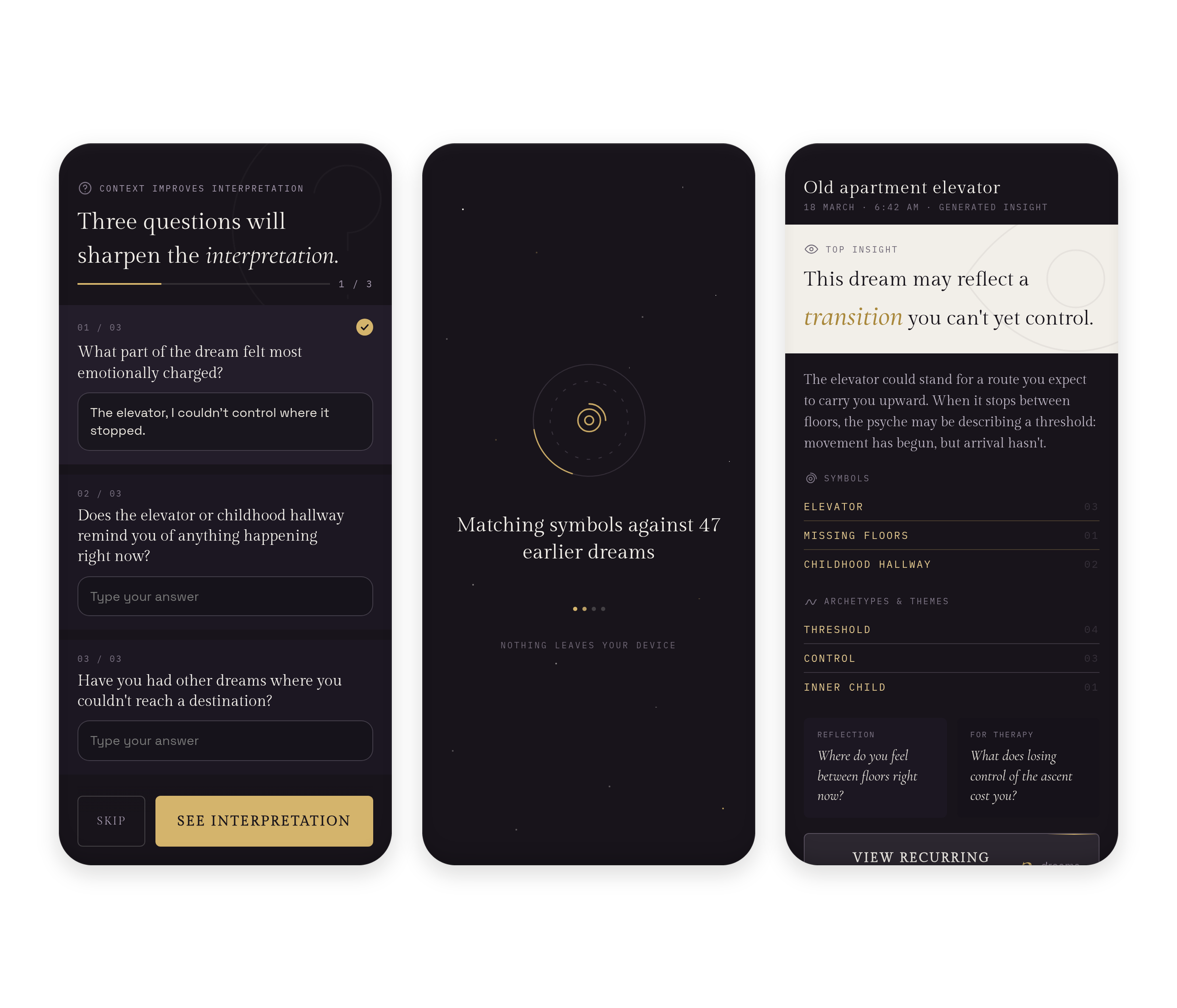
The AI Lab is where I make those questions tangible.
I use working prototypes to explore ideas that are easier to evaluate through interaction than through static screens.
The experiments range from money and decision support to human–AI interaction. AI helps me move quickly between an early idea and something I can use, question, and refine, but the interesting part for me is still the product decision: what should the experience help someone understand, what should it automate, where should it show uncertainty, and where should the person remain in control?
The Lab is intentionally experimental. My shipped work shows how that same judgment operates under real constraints; the Lab gives me space to test what might come next.
Let’s make something complicated feel clear.
I’m interested in teams working on products where the problem is genuinely complex, where good design depends on understanding the system, asking difficult questions, and collaborating closely through delivery.
I do my best work in environments where designers have room to think beyond the ticket, stay close to engineering and product, and improve not only the immediate experience but the foundations around it.
If your team needs someone who can bring structure to ambiguity and help complex work become clearer, more usable, and easier to ship, I’d be glad to talk.